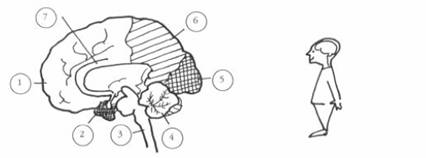
1. Frontal lobe (new brain/neo-cortex)
2. Limbic system
3. Brain stem
4. Cerebellum (little brain)
5. Occipital lobe
6. Parietal lobe
7. Corpus Colossum
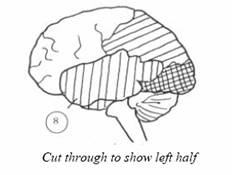
8. Temporal Lobe
Brain-friendly learning
http://www.brainfriendlylearning.org/tfs-sample.pdf by Mark Fletcher
Firstly, we should know that every brain (even those of identical twins) is unique, and constantly changes as we interpret and re-assess experience. The complexity is amazing. The brain is made up of anatomically distinct regions, and we shall think about the role of each, particularly in relation to teaching and learning. Whilst these different regions appear distinct, they are not autonomous mini-brains but form an integrated system in which the whole is, in some not yet clearly understood way, much greater than the sum of its parts.
This suggests that if we teachers plan lessons which simultaneously engage and stimulate several of these brain areas, our students will become more effective learners because this is how the brain itself naturally operates. Some of the brain areas do have particular jobs, but we mustn't underestimate how many brain regions are usually involved in any specific function (at least thirty areas of the outer surface of the brain are involved in processing vision, for example). In a similar way each brain area will contribute to many different functions. More is also becoming known about the plasticity of the brain, that is, the ability of one area, especially in children, to adapt to experience and take over functions from other, usually damaged, areas.
|
|
1. Frontal lobe (new brain/neo-cortex) 2. Limbic system 3. Brain stem 4. Cerebellum (little brain) 5. Occipital lobe 6. Parietal lobe 7. Corpus Colossum 8. Temporal Lobe |
|
|
Cut through to show left half |
Taking a look
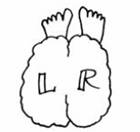 |
Looked at from above, the surface of the brain, the cortex, is seen as two distinct, very wrinkled, hemispheres joined down the middle .....
|
TWO HEMISPHERES
Much is heard about 'left or right' brain learning, but, if the brain is a complex integrated system, do the left and right hemispheres really have different functions?
The constant interaction of the two hemispheres of the cerebral cortex means that, for most of the time they are effectively one.
Nevertheless, brain imaging studies do confirm that, in normal circumstances, each hemisphere has specific strengths. The left hemisphere does seem to favour analytical, logical, time-sensitive processing. The right does seem to be more holistic, intuitive, involved with sensory perception rather than with abstract cognition. Whilst this is a useful distinction for us as teachers, we need to be a little wary of generalisations.
Even language, usually regarded as a definite left hemisphere attribute, is organised atypically in about five per cent of people. Again, as teachers, we will be interested not just in the different strengths of the two hemispheres, but in how they engage together in the learning process. Later we will consider why this interaction is so important and how we can facilitate it by using music, visuals and visualisation.
THE CROSS-OVER PRINCIPLE
The Corpus Colossum is a thick band of white tissue (nerve fibres) lying below and connecting the two hemispheres. it acts as a bridge between them. Most sensory input to the brain swiftly crosses via the Corpus Colossum from the incoming side to the opposite side for processing. This applies to visual, touch and auditory input. Smells are the exception to the 'cross-over rule' as they are processed on the same side of the brain as the nostril that senses them. The Corpus Colossum is, on average, thicker in the female brain than the male. Because there are therefore more pathways bridging the two hemispheres, such a difference might facilitate the synthesis of, for example, intuition (right hemisphere) and speech (left hemisphere). These are very early days for making generalisations, still less for drawing conclusions on that issue, but as teachers we need to be aware that research into the brain is beginning to provide help in differentiating how best to present information for learners of different ages, sexes and abilities.
Other parts of the brain
THE BRAIN STEM
This is formed from the nerve cells running from the body via the spinal column. It is the most ancient part of the brain in evolutionary terms and is sometimes called the Reptilian, or Reflex brain. Various clumps of cells in the brain stem determine the brain's general level of alertness, and regulate heartbeat, blood pressure, and breathing. Although the brain is roughly two per cent of body weight, about a quarter of heart activity is used to keep it supplied with the oxygen it needs to function effectively. The reflex brain therefore plays a major role in maintaining concentration. We have all probably experienced trying to teach a group of lethargic, oxygen-starved students who have been sitting slumped over their desks (which causes very shallow breathing) for half an hour or more. You can feel the energy level, and the interest, draining away.
Movement built into the lesson, some fresh air, the opportunity for the reflex brain to raise the heart beat and get oxygen to where it is needed, will relieve the stiffness and tension caused by sitting still, and greatly improve concentration levels
THE CEREBELLUM
This 'little brain' is also connected with movement. Looking rather like a small cauliflower, it perches at the back of the brain stem just below the main brain (the Cerebrum). It forms a smaller proportion of the whole brain in human beings than in creatures such as fish which depend on a constant coordination of feedback from the senses as they swim. Nonetheless, our brains too are somehow connected in a very basic way to the concept of movement. As we move around there is an interaction with an environment that is constantly changing. The Cerebellum has been called the 'auto-pilot' of the brain. The sensory motor coordination it generates underpins skilled movements that can be learned and practised and which become almost subconscious, like catching a ball, dancing, or driving a car. Most of the movements we make are effected by signals sent from the brain stem down the spinal chord and causing the appropriate contraction of muscles.
Interestingly, the fine motor movements, the dexterity of our hands in drawing, or playing the piano, or tool making, originate in a different part of the brain, a strip-like band fitting across the top of the highly developed brain and known as the motor cortex.
THE LIMBIC SYSTEM
The area nestling below the Corpus Colossum is generally called the limbic system and for teachers and learners this brain area holds the key to much of our success.
Emotions are generated in this region, along with most of our survival appetites and urges. The limbic system comprises a number of closely connected elements. The thalamus is a sort of relay station which directs incoming information to different brain areas for processing. The hypothalamus, together with the pituitary gland, adjusts the body to keep it optimally adapted to the environment. The hippocampus (so called because some say it looks like a seahorse, but for others looks more like a pair of ram's horns) is strongly associated with long term memory and the provision of a context for previous events. The amygdala, in front of the hippocampus, is a store house for emotional memory. It is where fear is registered and, as we shall see later, can under conditions of threat 'high-jack' normal rational behaviour with alarming classroom results. Anxiety is a great inhibitor of memory, and fear of making
mistakes or of ridicule, can trigger a 'fight or flight' reaction leading to either disruptive behaviour or opting out. At a basic level, students need the security of 'knowing where they are going' and the surety that if they miss something it will be recycled later on. They need the opportunity to be 'self-investing', that is, contributing something which is felt as being valuable, and also to be operating in a class environment where group support enables mistakes to be seen as steps on a learning ladder and not as demonstrations of stupidity. The role of the limbic system will be very evident when we look At the impact of emotion on memory, and think about self-esteem and confidence.
THE NEO-CORTEX
Cortex is from the Latin for 'bark' as this layer covers the brain as bark covers a tree. It has evolved to be much more extensive in human beings than in any other creature, and as noted earlier, has a convoluted, scrunched-up appearance because a lot is packed into a small space, our skulls. The main wrinkles, valleys and ridges are common to all human brains but the surface detail of each is slightly different. Both the right and left hemispheres are visibly divided by major folds into four lobes. The various lobes can, to varying extents, be associated with different functions, (always remembering that the whole brain is an integrated system). At the very back the occipital lobes are mainly concerned with visual processing. The top section, the parietal lobes, are associated with recognising objects through the senses and the coordination of input from the senses with movement. The parietalcortex is involved in our processes of making associations and is therefore a key region in the forming and storing of memories and in the mysterious process of thinking. To the side, from around the cars to the temples, lie the temporal lobes which deal with sound, speechcomprehension (usually left hemisphere only) and some aspects of memory. The pre frontal lobes (Neo-cortex, new brain) jut out forward. Neuro-scientists are agreed that the pre-frontal cortex is involved in the most sophisticated and integrated brain functions: that of thinking, planning, conceptualising, and the conscious appreciation of emotion.
This area also seems to be important for 'working memory'- the framework or context we employ when doing any task, and to have a crucial role in choosing appropriate social behaviour. It is the most significant brain area active in the formation of each individual personality. Finding out more about how such complex and abstract processes occur remains a huge challenge for researchers. As teachers we will want to consider what opportunities for challenge we provide for our students so that this extraordinary and powerful brain resource is brought into action in the learning situation.
One point to make now is that, as we each have a unique brain, it is not surprising that we do not all learn in the same way. The way our own brain learns best is our learning style. As teachers we have all met students with strong preferences. The Visual learners, 'Write it on the board, please. I need to see it before I can understand it'. The Auditory learners, 'Shhh. I need to hear that again.' They are quite happy to listen to a lecture, unlike the Kinaesthetic learners who get frustrated unless they can be physically involved in making, doing, moving.
BRAIN CELLS
The brain is composed of two types of cells. The Glia cells (named from the Greek for 'glue') which do the basic biochemical chores, and the neurons. It is the neurons which primarily concern us. There are an estimated 100 billion neurons. They are the most important cells in the brain (and the most specialised in our whole body). They form the connecting link between the world we perceive and the world we act on.
They carry the complex stream of information from the sense organs and nerves throughout the body to the brain structures, as well as outwards to muscles and organs.
Each of these neurons has a potential for about 60,000 connections with other brain cells!!! The neurons are concentrated in the grey matter, a 2-millimetre-thick layer on the outer surface of the cerebral cortex. This layer appears crinkly because it is scrunched up to pack a large surface into a small area (unfolded and spread out it would be about four times the size of this page). As an idea of the activity going on, imagine an enormous termites' nest .... it seems static, but below the surface is a seething bustle of unceasing movement, a vast confusion of individual insects converging, diverging, overlapping in traffic flows which to the observer appear uncoordinated, and yet obviously form patterns which have meaning and purpose in sustaining the colony.
The brain is an electrical and chemical system. This is not in any way meant to reduce the wonder of spiritual experience, of imagination and creative genius, of powerful and noble emotion, or to suggest that we can account for these things by what we know, or will ever know, about the nuts and bolts of brain cells. The purpose of this explanation is to provide teachers with enough information to understand why, in brain terms, certain attitudes and activities are likely to produce a positive learning environment whilst others have a negative effect.
Each neuron has a cell body. There are a number of characteristic shapes.
From the cell body sprout tiny branches called dendrites, after the Greek for 'tree'. Most neurons also have a single long fibre stretching from the cell body called an axon. Neurons generate electricity. The dendrites act as receivers bringing electrical signals from other cells to their cell body. If these signals are sufficiently strong , their cell body will generate a new signal in response, and the axon will pass this new signal on towards the next target neuron. The scientifically minded may want to know how a neuron generates electricity, or how an individual cell body copes with the barrage of incoming signals and 'decides' what action to take.
Please consult one of the excellent neuro-science books in the Reference List for that degree of detail. For most of us it is sufficient to know that next comes a very important chemical step in the process. Neurons are not joined together in a kind of net. There is a gap, a synapse, between them. The most common form of cell-to-cell contact is when the tip of an axon forms a synapse with a dendrite. Now the electrical signal has to jump the gap - but how? As soon as the electric impulse reaches the tip of the axon it creates the right conditions to release one of many diverse chemical transmitters into the synapse. The stronger the electrical excitement, the more chemical will be released. The chemical transmitter crosses the gap and 'docks', but only with the specific receptor on the target cell which is precisely made to receive it.
The versatility of this chemical system is almost incomprehensible. There are some hundred billion neurons in our brain, Each can make thousands of these synaptical connections. By having different amounts of different chemicals with different actions operating to different extents at different times the brain is in a state of constant chemical change.
Trying to distinguish some very closely connected concepts
Brain - a physical part of the body. Because it is involved in everything we do - and is constantly hanging - it is often personalised and given characteristics. These characteristics are more accurately a feature of the mind which is how the brain interprets the brain's interaction with the world.
Consciousness is to do with a personal awareness of feelings about those experiences
A BRAIN-friendly checklist for lesson planning
The technique applies equally to exam preparation lessons, management training, or teaching young learners.
Check 1 for Left hemisphere
Will the students recognise a logical progression in this lesson? Does it have a clear timetable fit - or if not, can I explain why it is useful? Are there opportunities for questions and answers, getting to grips with rules, structured practice? Have I got the timing right?
Check 2 for Right hemisphere
What is there in this lesson to engage the intuitive, holistic, fanciful faculties? is there an opportunity for students to visualise situations, to see the 'big picture' not just a small item of target information. Are we using colour for underlining, highlighting? If we are doing skills work, such as summarising or giving talks, 5 are we using non-linear note taking (mind maps)? Have I included music to establish moods (high energy/calming) and to work in conjunction with language (a quiet music 'passive' review of lesson content, or a suggestopedic ,concert reading' session).
Check 3 for the Reflex brain.
Where are the occasions for breaking the 'bunched over desk' posture, raising heartbeat and getting good supplies of oxygen pumped around the brain? Have I thought about stretch breaks or times when students are moving around, changing places, collecting material etc.?
Check 4 for the limbic system.
Memory and emotion are closely associated, so what does this lesson provide so that students 'self invest', contribute their own ideas and feelings, or get positive feedback from colleagues and teacher? is there an opportunity for team-building, pair and group work? Are the expectations I give about the target material encouraging (eg NOT I'm sorry we've got to do this because it's difficult and not much use but it's part of the syllabus)? Are my correction techniques conducive to building a healthy 'inner learning environment' showing respect for the learners and avoiding sarcasm or causing embarrassment?
Check 5 for the neo-cortex (new brain).
The brain likes to say 'Thank you for that input - now I want to 'claim' the new knowledge for myself.' Does the lesson contain opportunities for students to be original with the target concepts through role play, tasks etc? Is there a chance for students to experiment and find out how the rules/boundaries operate?
Check 6 for learning styles.
Can I look at this lesson and say 'Yes. There is a built in safety-net so that auditory, visual and kinaesthetic learners will all be able to get bold of the content'?
� PHOTOCOPEABLE PAGE � TEACHING FOR SUCCESS � ENGLISH EXPERIENCE �
Some examples you can download at: http://www.brainfriendly.co.uk/free_samples.php
|
|
|
|
|